


Agricola All Creatures...
3.865.00 Reviews
App Specs
- Version
- 207
- Updated On
- License
- $4.49
- Downloads
- 10,000+
- Developer
- Twin Sails Interactive
- Categories
- Board
- Platform
- Android, iOS
Screenshots
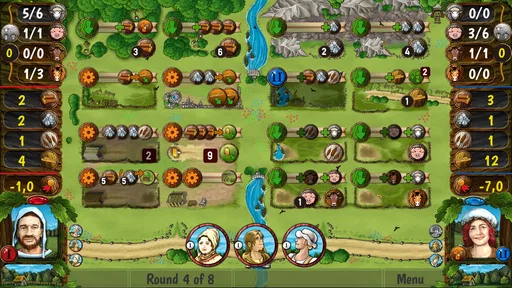
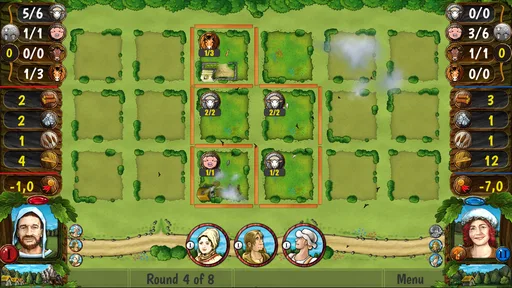
 Analysis by AppCompare
I spent time with Agricola All Creatures as a focused two-player board game on mobile, and my first impression was that it asks for a different kind of patience than most casual games. It is not built around quick taps, constant rewards, or a long list of opponents. Instead, it turns livestock breeding into a compact strategic contest where every decision affects the shape of your farm and the options available a few turns later.
That narrow focus is also its main appeal. Developed by Twin Sails Interactive, this digital adaptation is aimed at people who already enjoy thoughtful tabletop games or who want a serious head-to-head experience without setting up a physical board. I found it most satisfying when I had enough time to think through several possible plans rather than simply reacting to the current move.
The game sits in the board category, carries an Everyone age rating, and costs $4.49, with optional in-app purchases priced at $2.99 per item. It was released on Aug 9, 2016, and the current version is 207. Those details place it in the paid, dedicated-game part of the mobile market rather than the free-to-start casual crowd, so the right question is not whether it offers endless variety for nothing, but whether its concentrated strategic experience suits you.
How the two-player design feels in everyday play
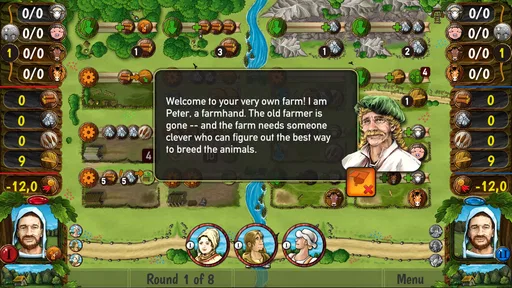
The central experience is deliberately intimate: one opponent, one farm, and a limited number of opportunities to improve what you have built. I liked that the format makes every move feel legible. When I chose an action, I could usually understand what I was gaining, what I was giving up, and which future option might disappear because of that decision.
That clarity makes it easier to return to than a sprawling strategy game with a huge ruleset. At the same time, the game is not lightweight in the way a simple matching or dice app is lightweight. Even when a session feels compact, the decisions can be demanding because a small early preference can influence the rest of the farm. I often found myself weighing immediate livestock growth against the space, structures, or resources needed to support it later.
The livestock theme is more than decoration. It gives the game a practical rhythm: acquire animals, create room for them, improve the farm, and avoid letting one attractive choice create problems elsewhere. The best turns are rarely about taking the most obvious reward. They are about making the farm work as a system.
For a newcomer, that means the first few plays may feel slower than expected. I would not judge the game after a single hurried attempt. The value appears once the relationship between space, breeding, and development starts to make sense. After that, the same board can feel much more open because you begin seeing several routes instead of only the action that looks strongest at first glance.
Worth Reading Before You Choose

EA SPORTS FC Mobile 26 Is a Bigger Football Game, but It Takes Time

Flipboard Shows What News Apps Must Do Beyond the Feed

Switching to Android Auto Means Rethinking Your Driving Routine

Google Calendar Makes a Crowded Week Easier to Manage

Ludo King Makes the Most of the Minutes Between Plans

Baby Panda World Brings Quick Play to Modern Phones, but Its Game Library Feels Busy
Speed expectations: thoughtful rather than instant
In terms of perceived speed, this is a game for deliberate turns. The interface itself is not the main source of tension; the thinking is. I could move quickly when I already had a plan, but the interesting turns were the ones where two useful actions competed for attention. That makes it a good fit for a short break if you enjoy concentrating, but a poor match if you want something that can be played almost automatically while watching another screen.
The two-player structure helps keep the experience focused. I did not have to manage a large group of virtual rivals or wait through a long chain of unrelated turns. However, a focused game can still feel slow when I paused to calculate the consequences of breeding, construction, and available space. The app is best approached as a board game session, not as a reflex game with a board-game skin.
One useful habit is to decide what your farm needs before looking for the most tempting action. I found that starting with a simple priority—more room, better animal support, or a stronger short-term economy—reduced hesitation. It also prevented me from spending too much time comparing every possible option when only a few actually supported my plan.
Another practical tip is to treat open space as a resource, not as empty decoration. A crowded farm may look productive, but it can restrict the next useful improvement. I became more consistent when I left room for the plan I expected to follow instead of filling every available area immediately.
Heavy-use moments and decision pressure
The most demanding moments arrive when several parts of the farm need attention at once. I might want to expand, improve animal capacity, and prepare for the next breeding opportunity, yet the available actions force me to choose. Those moments are where the game feels richest, because the challenge is not simply collecting more; it is deciding which shortage matters most right now.
Longer or more thoughtful sessions can therefore feel mentally heavy even if the app itself is not doing anything visually extravagant. The pressure comes from tracking consequences. I had to remember what my opponent was likely pursuing, what space remained, and whether an action would solve a problem or merely postpone it.
This is also where the game separates itself from many familiar mobile board alternatives. A quick digital card game may give you more immediate variety and faster rounds, while a broad digital board-game collection may offer more themes and modes. Agricola All Creatures is narrower, but its narrowness gives the contest a sharper identity. The farm is the whole conversation, and that makes the rivalry easier to follow.
I would especially recommend it for two friends or partners who enjoy comparing decisions after a match. Because there are only two players, it is easy to discuss why one person prioritized animals while the other invested in the farm itself. That kind of post-game conversation is part of the appeal, particularly for people who enjoy tabletop strategy but do not always have a physical copy available.
On the other hand, I would skip it if your ideal mobile game is a relaxed solo activity with no pressure from another player. The head-to-head format makes the opponent central to the experience. Even when the rules are approachable, the game does not become a passive farming simulator where you can simply build at your own pace.
Reliability and returning to an unfinished plan
My overall impression was of a compact adaptation that rewards repeat play. The current version is 207, which suggests the app has continued through multiple revisions rather than being left as an untouched early release. I still think it is wise to keep expectations appropriate for an older mobile title: its appeal is the board-game structure, not a modern presentation designed to overwhelm you with animation and spectacle.
For reliability, the important question is how well the app supports the way you actually play. If you prefer completing a session in one sitting, the focused format works naturally. If you tend to interrupt games frequently, your experience will depend more on how comfortable you are returning to a strategic position and reconstructing your intentions. I found that making a mental note of my next priority helped more than trying to remember every possible line.
Recovery after a mistake is another important part of the experience. A poor early choice does not necessarily make the rest of the game meaningless, but it can change the kind of recovery you need. Instead of chasing the plan that no longer fits, I had better results by identifying the farm’s new strongest feature and building around it. That is a useful lesson for new players: adaptation is often more valuable than trying to force an ideal opening.
The game also benefits from being readable. When the board state is understandable, I can recover from a lapse in attention more easily than I could in a game filled with hidden effects and constant interruptions. The trade-off is that the responsibility for remembering the strategic context remains with me. This is not an app I would choose when I want the software to do all the thinking and explanation for me.
Its average rating is 3.8 from around 600 ratings, with roughly 65 written reviews. I read that as a sign of a game with a clear audience rather than a universally effortless recommendation: people who want this specific two-player strategy format are likely to appreciate it more than players arriving for a broad, casual farming experience.
Device constraints and resource expectations
The minimum operating-system requirement is Android 5.1, so the game is accessible to a wide range of older Android devices. That is useful if you keep an older phone or tablet for games, although compatibility alone does not guarantee that every device will feel equally comfortable. Screen size matters for a board game because small controls and dense information can make careful planning less pleasant.
I would choose a larger phone or tablet when possible, especially for longer sessions. A bigger display makes it easier to inspect the farm, compare available actions, and avoid accidental taps when several elements sit close together. This is less about raw power than about reducing visual friction during decisions.
The game does not present itself as a graphics-heavy production, and its strategic board format should make it less demanding than an action game built around elaborate real-time scenes. Still, I would avoid judging resource use solely by visual simplicity. A turn-based board app can remain open for a while, and longer sessions may be more comfortable on a device with a healthy battery and a stable screen response.
If you are installing it on an older device, I would leave enough storage for the app and its normal operation, keep the operating system updated as far as that device allows, and close unrelated apps before a serious session. Those are ordinary precautions, but they matter more when you are relying on an older phone and want to avoid interruptions during a carefully planned match.
The optional purchase structure is worth considering before you install. The base price already places it among paid mobile board games, while additional items cost $2.99 each. I would approach those extras as optional additions rather than part of the reason to buy the game. If your preference is a single purchase with no further decisions, check how much of the experience you want before spending beyond the initial price.
Who will enjoy it, and who should choose something else
This is a strong choice for someone who wants a serious two-player board game with a farming theme and enough strategic tension to reward repeated sessions. It also suits tabletop players who enjoy learning a system gradually, then discovering that familiar actions have different value depending on the opponent and the state of the farm.
I would recommend it to a couple looking for a shared evening activity, to friends who like comparing tactical choices, and to experienced board-game players who want a portable version of a livestock-focused contest. It can also work for a solo learner who is willing to use early games to understand the flow, although the competitive relationship between two players is what gives the design its strongest personality.
I would not recommend it to someone seeking a broad collection of modes, a social party game, or a fast game that can be completed without concentration. It is also not the best alternative to a relaxed farming simulator. Here, animals and farm improvements are tied to competition and efficiency, so the emotional experience is closer to optimizing a small strategy puzzle than decorating a peaceful homestead.
Compared with a physical copy, the app is more convenient because there is no setup, no need to find or store pieces, and no second person required to calculate every rule manually. The physical version can still be better for players who enjoy handling components, discussing moves across a table, or teaching with the board in front of them. The mobile version wins on portability; the tabletop version may win on atmosphere.
Compared with a casual digital board game, this one demands more commitment but gives decisions more lasting weight. Compared with a large strategy title, it is easier to keep the whole contest in view, though it offers a more specialized theme and a tighter player count. Those trade-offs define the purchase more clearly than the livestock setting alone.
Small habits that make the experience better
My most useful approach was to separate immediate needs from long-term goals. If the farm lacked basic capacity, I dealt with that before chasing an attractive improvement. If the structure was already stable, I could afford to think more aggressively about breeding and denying my opponent a useful opportunity. This simple distinction made my turns faster without making them careless.
I also learned not to copy the opponent’s plan automatically. In a two-player game, it is tempting to mirror whatever looks successful across the board. That can waste valuable turns, especially when the other player has already shaped the farm around a different priority. Watching the opponent is important, but their plan is information—not necessarily an instruction.
A third insight is to evaluate a move by what it enables, not only by what it provides immediately. An action that appears modest can be powerful if it opens a better sequence on the following turns. Conversely, a large reward can be awkward when it creates a space or capacity problem you are not ready to solve. This is the kind of detail that the store summary cannot communicate, and it is where repeat play becomes worthwhile.
Finally, I recommend treating the first session as orientation rather than a test of skill. The game’s systems become easier to read once you have seen how an early choice develops. Trying to play perfectly from the beginning made me slower and less willing to experiment. Accepting a few inefficient turns helped me understand the structure much faster.
Final performance verdict
From a performance perspective, my verdict is favorable for the kind of app this is. Its perceived speed comes from focused turn structure rather than flashy presentation, its heavier moments come from strategic calculation, and its resource demands should be more approachable than those of a real-time action game. The main friction is not that the game is overloaded; it is that careful play naturally takes time and attention.
The paid entry price of $4.49 is reasonable if you specifically want this concentrated two-player board experience and expect to replay it. The optional $2.99 items make the total commitment less simple, so I would decide in advance whether the core game already meets your needs. With an Everyone rating and support beginning at Android 5.1, it is also an approachable choice from a device and age-rating standpoint.
My honest recommendation is to buy it when you want a portable strategic contest for two, especially if livestock breeding and tight farm management sound more appealing than quick rounds or decorative simulation. I would pass if you want a constantly changing catalog of activities, a carefree farming app, or a game that plays itself while you multitask.
After playing it, I came away appreciating its restraint. It does not need a huge world to create meaningful decisions. It gives me a small farm, a rival, and enough competing priorities to make each turn matter. If you enjoy thinking before you tap, this is one of the more focused board-game experiences worth considering on mobile.
Pros
- Faithfully adapts the strategic farming board game for mobile play.
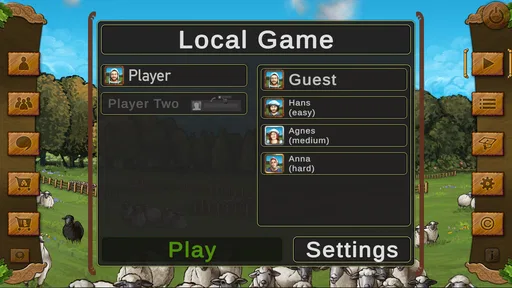
- Solo mode offers challenging AI opponents with adjustable difficulty.
- Shorter matches make it suitable for quick gaming sessions.
- Clear resource management creates satisfying tactical decisions.
- Pass-and-play support lets two players share one device.
Cons
- The rules may feel overwhelming for players new to worker-placement games.
- Limited content can reduce replay value after mastering the available animals.
- Small interface elements may be uncomfortable on compact phone screens.
- Matches can become repetitive without additional scenarios or expansions.
- Careful planning is required
- so it may not suit casual players seeking quick action.
FAQs for Agricola All Creatures...
What is Agricola All Creatures Great and Small?
Agricola All Creatures Great and Small is a digital adaptation of the popular two-player farming board game. Players develop a small farm, build important structures, acquire animals, and try to create the most productive homestead. The app focuses on strategic planning rather than fast action, making it a good choice for board-game fans who enjoy thoughtful turns and long-term decisions.
How does the gameplay work in Agricola All Creatures Great and Small?
Each player takes turns placing workers on available action spaces to collect resources, expand the farm, construct buildings, and obtain animals. Because action spaces can only be used by one worker at a time, choosing the right moment is essential. The game becomes increasingly strategic as players balance limited resources, farm space, animal capacity, and scoring opportunities.
Can I play Agricola All Creatures Great and Small offline?
The game is generally designed to support local play against computer-controlled opponents, which makes it suitable for playing without a constant internet connection. Offline availability can depend on the specific version, device, and installed updates, so it is worth checking the app-store description before downloading. Online features, if offered, may require an active connection.
Is Agricola All Creatures Great and Small suitable for beginners?
It can be enjoyed by beginners, although the rules may feel demanding at first because the game includes several resource types, buildings, animal-management decisions, and scoring considerations. The tutorial or introductory guidance is useful for learning the basic flow. New players should expect a short adjustment period before they understand how to plan efficient turns and avoid wasting valuable actions.
Does Agricola All Creatures Great and Small include multiplayer features?
The app is primarily focused on the competitive two-player experience represented by the original board game. Depending on the platform version and available updates, multiplayer may include local pass-and-play or other supported modes, while online functionality can vary. Before downloading, users who specifically want online matches should verify the current feature list and compatibility information in the relevant store.


